Wednesday, July 11, 2012

Nikko: Lush, Historic Tourist Town


What struck me most about Nikko initially was its size:  at 90,000 it is one-tenth that of Tokyo, so it immediately felt like a small town.  I stayed in a rustic inn on the banks of the river, listening to the sound of rushing water as I went to sleep.  My visit essentially kept me on the main street, so Nikko also felt like a one-street town, even though it clearly isn’t.


And is Nikko lush!  I literally drank in the greenery of forested hills, the stands of towering cedars at the World Heritage site, ferns and moss growing everywhere.  It’s the rainy season, too, so there is mist or rain to add to the river, waterfalls, and little channels carrying water downhill.  My favorite sites were the stone lanterns guarding the temples and shrines, festooned with hats of moss and fern.  I had the feeling that, if the wooden temple buildings were not replaced every twenty years as is the custom, the walkways not weeded frequently, or the grounds maintained, the place would be overgrown in a century.

Nikko is famous because it houses the shrines and mausoleums of Tokugawa Ieyasu and his grandson, Tokugawa Iemitsu, and is the home of a Buddhist sect.  Tokugawa Ieyasu is the warlord who united Japan and established the shogunate that ruled Japan for 250 years until the Meiji restoration in 1868.  Tokugawa Iemitsu centralized the country’s administration and closed Japan to the West.  The complex of shrine and temple buildings forms a World Heritage Site that attracts thousands of tourists each year.
 
Toshu-gu, the shrine for Tokugawa Ieyasu, was originally built in the 1630’s by  Tokugawa Iemitsu.  It is awesome, like many buildings constructed to show off the owner's power and wealth. The shrine’s buildings are richly painted and decorated with woodcarvings of trees, animals, birds, and flowers.  A storehouse has carvings of monkeys portraying “see no evil, hear no evil, speak no evil”.  The walls surrounding the main building have panels, each different, of birds and trees and the ceilings are richly painted.  One has a dragon covering the entire ceiling.  When you clap two pieces of wood together, the sound reverberates in what might be construed as a dragon’s (soft) roar.

There are a number of gates before you can enter the main building, starting with a simple wood torii and becoming more elaborate until the last, ornately carved white-painted gate.  The latter gates have scenes of people and priests, full of life and humor.  For the last gate, it is said that the workmen turned one of the pillars upside down, fearing that the gods would become angry at such a lavish gate. 

Tokugawa Ieyasu’s tomb, however, is quite simple.  You go through a low gate, up a path of stairs to a small, walled in area with his tomb, a large stone cylinder, simply carved, with a roof.  A crane and a turtle, symbols of good fortune and longevity, guard the tomb.  It was quite moving.

Women weeding the rocks
I also visited Tokugawa Iemitsu’s shrine – less elaborate but still quite wonderful – and the other buildings and temples, walking on stone paths up the hills to those less frequently visited by tourists and groups of school children.  It was here that I realized what a job it was to keep the forest and the rain from reclaiming these buildings; you could almost watch the moss and seedlings creeping towards them.

Part of Nikko's main street
As I walked down the main street to dinner, I saw a number of tourist shops, mostly selling “omiyage”, tourist gifts the Japanese take back to their friends.  Many stores seemed empty, closed, or vacant.  When I asked my innkeeper, he said that this is the rainy season, so of course there are few tourists.  The really busy time for Nikko is in the fall, when the maples are turning and the air is crisply clear.


Women on the train to Mashiko
Shoji Hamada pottery


I took a day trip to Mashiko, a nearby pottery town.  There’s a couple of nice pottery museums showcasing the work by Shoji Hamada, a Mingei folk-art potter and a living national treasure who put Mashiko on the map.  Mashiko certainly is a pottery town:  there are 380 different potters, who make everything from heavy, earthen and ash-fired work to everyday dishes to lighter and more refined work.  

Saturday, July 7, 2012

Nuclear Power and Little Adventures


Nuclear Power.  Many of you have seen articles reporting an independent commission’s conclusion that the Fukushima accident was man-made, due in part to a close relationship between TEPCO (the electric power company operating the reactor), the nuclear regulatory commission, and the government.  The news came a few days after Japan restarted its nuclear reactor in Oi, the first since all were shut down after the disaster.  You also may have read of protests about the restarting and the roughly 50,000 people marching in front of the prime minister’s residence.  For the non-confrontational, quiet Japanese, this was a significant number.

I’ve talked with some of the people I’ve met in Tokyo about the restart.  What has impressed me most is that the Japanese seem very aware of the clear trade-offs – no nuclear reactors means a 15-20% drop in electrical power, which will affect virtually every individual, business and the economy – and they are willing to make that choice.  They did it last year because they had to; now they are willing to do so permanently.  A recent survey showed that 70% of the people oppose restarting the reactors and are willing to limit their electrical consumption, including having less air conditioning as the hot and steamy summer approaches.  Some I talked with echoed this sentiment, while others were conflicted, feeling there needed to be at least some nuclear power but uncomfortable about the safety issues.  There seems to be a deep mistrust of the government’s willingness or ability to ensure its reactors’ and hence its people’s safety.  That, Tokyo’s apprehension that the next big earthquake will happen near here, and ongoing concerns about the economy and Japan’s declining population, make for an undercurrent of malaise here.

In listening to the talk about the reactors, my thoughts turned to how this might apply in America.  I leave it to you to think about cozy business/governmental relationships and choices we may be asked to make in the future.

Little Adventures.  Any trip is a montage of adventures.  As I get ready to leave Tokyo and head north to the Tohoku region, I thought I’d report on some I’ve had these last few weeks.

Hakone.  This week, Yuko and I went to Hakone, southwest of Tokyo in the Mt. Fuji region.  The last leg of the trip was on a train that zigzagged back and forth up a mountain, stopping at a station then reversing itself along the way.  We first went to the out-door sculpture garden, a nice-sized park of contemporary sculpture, mostly by Japanese but also by Europeans and a few Americans.   There was also a museum of Picasso drawings and ceramics, where the building shook as a small (4.0) earthquake hit somewhere in the region.  The garden was smaller than Storm King, north of New York, and didn’t allow you to walk on the lawn around the sculptures.  But they were interesting pieces, particularly because they were by people I didn’t know.  We especially liked the sculptures made for children to explore.

By a Costa Rican sculptor
Yes, that's a child climbing inside!
In the afternoon we went up the ropeway (i.e. gondola) to the top of the mountain.  By now it was misty, so there are no pictures of us going through the fog, with a descending car emerging out of the white.  As we neared the top, we could look down to see a huge sulfur quarry, used to supply the hot springs below.  By this time it was raining and I decided I really didn’t want to trek around in my sandals over slippery rocks to peer over the edge of the quarry.  We headed back down the mountain, took a train to Tokyo, and stopped at a transfer point to have a great sashimi dinner at a local restaurant. We had a great day, even in the mist and rain.

Sachiko Kashima
The “crazy curator”.  This is a picture of a woman named Sachiko Kashima.  She told me "Sachiko" means “happy” and indeed she is.  I met her a few weeks ago at a gallery in the Ginza section of Tokyo.   Somehow a conversation started, one thing led to another, and she took me to her apartment along with the woman friend she was with.  There I learned she had been a curator at a private museum in Kyoto, where she had put together an exhibition on Noh theatre during the Edo period.  While she specialized in textiles (I think), her training required that she learn about all the arts, so she was expert in pottery, calligraphy, etc.  In between three sets of afternoon tea, each with a different tea and sweet, she showed me a very old, beautiful green Noh costume, scrolls, and lacquer boxes she had collected.  As I left, she handed me a used shibori kimono to use in my quilting and said, “call me and we’ll do something next week.”

I’ve seen her twice since, which is no mean feat since she doesn’t use a computer, is often out when I call her, and we can barely understand each other. The second time she had inadvertently “overbooked” so we first went to a nearby hospital clinic where she had a doctor’s appointment.  Through her and another person I’d met, I learned that everyone in Japan has health insurance and that a hospital/clinic must see everyone that comes in.   You can also choose your doctor, making an appointment at the clinic where he/she works.  The wait may be a bit long, the appointment itself a bit short, but everyone gets treated. 

Next we went to the Mori Museum in a skyscraper to see an exhibit of contemporary Arab art.  I don’t know that she liked it much, and not all of it was good, but it certainly was expressive of a deep anger at a modern soul-less world and the unending, senseless violence between Palestine and Israel, despite religious and political leaders’ statements advocating peace and tolerance.  Afterwards, we went to the observation floor and looked out at Tokyo on a beautiful sunny day.  We finished by having a sashimi dinner nearby and talked about meeting later in the summer in northern Japan. 

It has been an amazing experience with Kashima-sensei and I have no idea why she befriended me.  She is lively, bright, and has a wonderful style about her. She’s also quite strong willed and something of an imp, laughing and making me laugh at what we do together.  I don’t know if we will manage to see each other again, but I will certainly try.


Shoes.  As I rode around Tokyo on the commuter trains, I started noticing the variety of footwear that people wore.  True, there were a lot of black shoes worn by the salary men and women on their way to work.  But there was a lot of style, too, not just worn by women but also men.  There is also a wide variety of socks and stockings that are part of “the outfit”.  One store had a huge display of five-toed socks (popular here), lacy crews, and little “sockettes” with a pretty band across the foot to hold it in place, all in a range of pastels.  So, for the fun of it, here are some of the feet I saw.

Thursday, June 28, 2012

Tokyo Respite


One of the great joys of spending a year traveling is that you get to experience a country's seasons.  In Japan, I’ve found people love to celebrate the changing seasons through its flowers and trees.  In March there was the eager count-down to the cherry blossom season.  In April people across the country celebrated in festivals beneath thousands of cherry trees.  The fall will bring a similar delight in the bright colors of the maples.

Now the iris and hydrangea are blooming.  I have joined the Japanese in strolling through  gardens, looking at the flowers, sitting to enjoy the scene or picnic on the lawn.  
 

These photos are from a number of gardens in Tokyo, including the Imperial Palace East Garden, which has 84 different varieties of iris.  As with any occasion, the Japanese (like me) took pictures, with cameras ranging from smart phones to SLRs with 18” lenses.  


These hydrangea photos are  from a shrine and park called Hachimangu in the town of Mito about an hour outside of Tokyo. 


I don't think I've seen so many  hydrangea with so many varieties in one place.  The plants were mostly under a stand of tall trees.  It was all quite lovely, serene, and cool.


Mito has a lovely lake with a path around it for joggers and strollers,  a fountain in the middle, swan boats and real swans.  A lot of people were out, including this mother and son, whom I saw at the train station as we waited to return home.  (Another thing Japanese love is hats!)
Yesterday I went to the Edo- Tokyo Open-Air Museum, a collection of houses and shops from the early 1900's.  There the iris were gone, but dahlias were in bloom.  As I walked home from the train, there was a beautiful sunset.  I wasn't the only one taking pictures!

Monday, June 18, 2012

This is Your Spaceship Calling….


Remember those movies we saw of future cities on earth, with glassy skyscrapers and monorails and deserted streets?  Well, that’s what Odaiba felt like when I saw it this week.  The guidebooks describe it as space-age buildings, electronic cars, and fantasy shopping malls.  It’s really strange.


Oldenberg's "Saw Sawing"
Tokyo big Sight
 Odaiba is a complex of office buildings, apartment houses, malls, and entertainment venues built in the 1990’s on landfill in Tokyo Bay. A new, conductor-less subway line takes you there from Shimbashi, tucked under the upper level of Rainbow Bridge and nestled between the car lanes.  When you “land”, you are greeted with large buildings, some your stereotypical skyscraper but some not.  There’s Tokyo Big Sight, a building of inverted pyramids, which is an event space.  There are a couple of massive buildings with glass bridges joining the towers high above ground.  And there’s the Fuji Television building that looks like a giant erector set.  Decoratively placed among them is Claus Oldenberg’s “Saw Sawing”.  No comment.


Fuji Tower
Odaiba has its share of museums, geared to Odaiba’s past (it was a shipping port) and future (innovation).  The National Museum of Emerging Science and Innovation, the only one I went to, was fascinating, with interactive exhibits on genetic research for cancer and other diseases; robotic arms you can manipulate to try your hand at surgery; the role of serendipity in inventions; etc.  The National Maritime Museum, built like an ocean liner, looked the most interesting from the outside.  There’s also a Port Museum and Museum of Maritime Science.

This is a corporate village, too.  Toyota has a huge showroom of its current, future and past automobiles, and you can see the latest in its electric cars.  In the Fuji TV Broadcast Center, you can see how television programs are made and go up to the observatory to see Odaiba and the Tokyo skyline.

Anniversaire Tokyo Bay
Big Box Stores
Odaiba aims to be a destination spot, which means it has a wealth of entertainment and shopping opportunities.  In my wanderings around the island, open-mouthed, I saw several mall complexes with all kinds of shops, even ones we have back home.   There are restaurants of every style you can imagine, a number of theme areas à la Disneyland, an onsen/spa, etc.  My favorite was a semi-European looking “Anniversaire Tokyo Bay” complete with a church, which I think is available for weddings.  You can see it in the picture here, in front of the huge Hotel Trusty and the Baycourt Club. 

I will say the Ferris wheel was great.  It was the world’s tallest in 1999; I don't know if it still is.  If you wanted, you could ride in a clear cab and see the ground below as well as the skyline ahead.

I went to Odaiba on a weekday, so it was fairly deserted, which added to the out-of-body space age feel.  There were large, wide avenues, grass, new trees, a pedestrian bridge, sidewalks and walkways.  From the Ferries wheel, I could see huge areas waiting to be built upon; they were either parking lots or grass fields (“a wildflower garden”, one said).  With the recession, they may wait a long time.

In some ways, Odaiba is not that different from the other large office/residential/shopping complexes I’ve seen around Tokyo, though the others are more refined in their architecture and not quite so over-reaching or Disney-like.  Both have wide green spaces and have a more open feel than “old Tokyo”.  But they all have a certain anonymity and lack of human community about them, quite different from the Tokyo of even 40 or 50 years ago.

Pedestrian Bridge
The contrast between the “old Tokyo” and the “new” Odaiba was quite stark for me.   The day before, friends and I visited the Shitamachi Museum, which is a reconstruction of Tokyo shops and houses from the early 20th century.  It reminded me of other exhibits I'd seen of even earlier times.  In their 60's now, Mune and Shigeko had grown up in similar houses, so could explain a lot.  Mune talked about his family of five living in three four-tatami mat rooms and a kitchen.  Shigeko showed me where the futons were stored, clothes kept, how the kitchen worked, etc.  What was most fun was watching them play with the children’s toys on display.  Everything we saw there they had used or done.  Much is still true today:  drying clothes on poles on the balcony is a common sight, and even western-style houses will have a tatami mat room.  But that way of living is fast disappearing.  With Odaiba, there is no trace.

The really strange thing about Odaiba is that it is built on landfill.  One reason is that Tokyo has limited area for expansion, so building out into the sea can be attractive.  Another Japanese friend explained that, after Admiral Perry landed in Tokyo Bay, the government began filling up part of the bay as a way to shore up its defenses.  She said it took until the 1980’s before the land was ready to be built upon.  But, as she pointed out, it may not be the sturdiest of ground.  It’s in an earthquake zone.  And if there’s a tsunami, as many fear, the island could well be destroyed.  So here’s this futuristic urban complex, erasing Tokyo’s past while hoping a tsunami won’t obliterate it.  No wonder my head is spinning!

Monday, June 11, 2012

Tokyo Is….


Tokyo has so many facets to it that it is almost impossible to do the city justice.  I’ve traveled to many places in the city over the past two weeks:  to Akihabara, still electronics heaven but now transformed into an anime capital; Asakusa with a shrine that is anything but quiet or spiritual as the tourists flock to it; the posh Ginza area, and many others.  I’ve seen the Natural Science Museum’s park, deliberately kept wild as a research facility; the Edo-period Hamarikyu Garden, with a brand new building complex behind it; and the large Shinjuku Gyoen with its wide lawn that reminds me of Central Park.  And I’ve seen some oddities.   So, without further ado, here’s a collage of my Tokyo wanderings to date, with a bit of commentary about what Tokyo is to me.

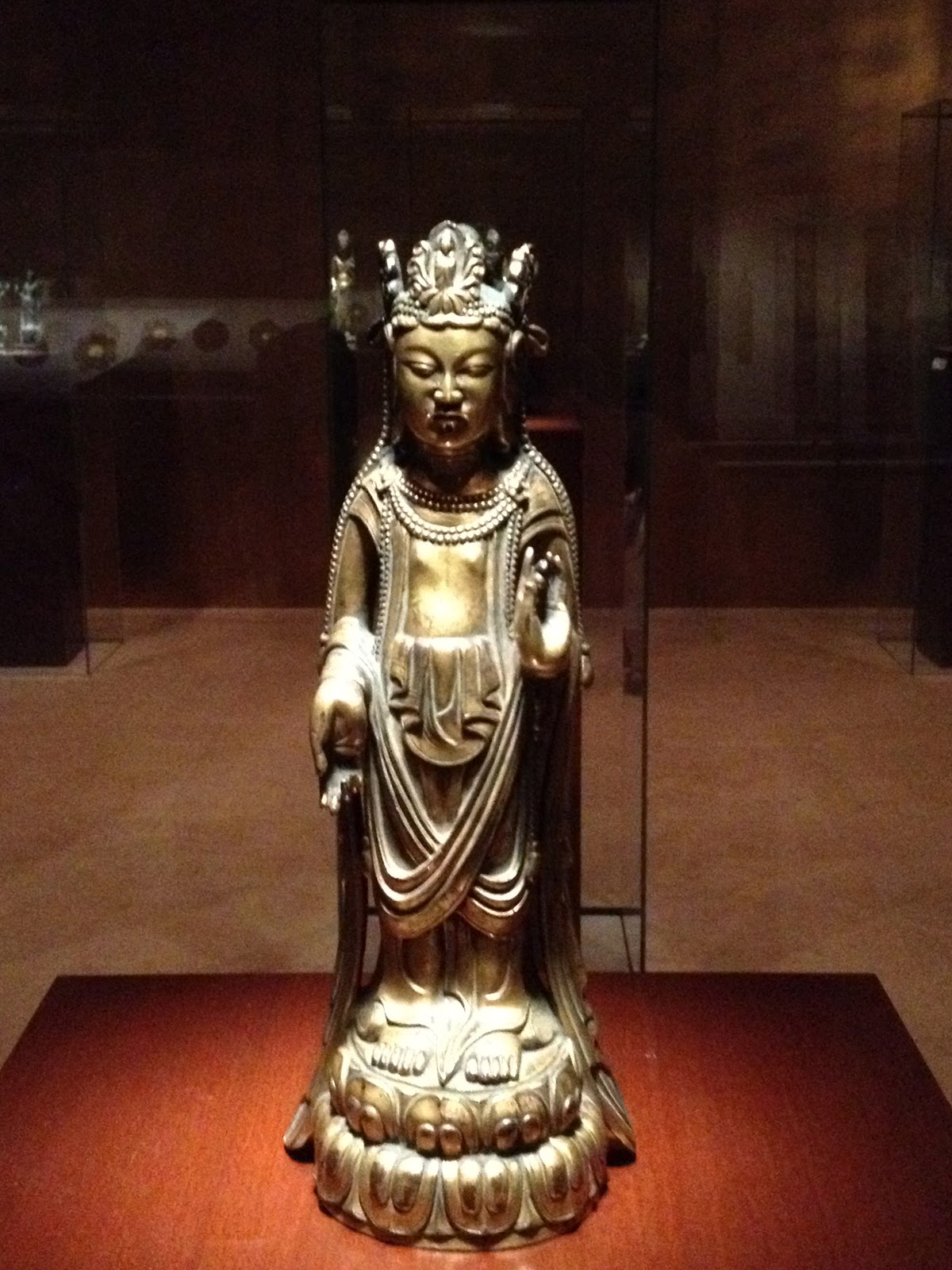
Tokyo is old and new, as I wrote in my last blog.  The National Museum’s Horyuji Gallery preserves 7th and 8th century treasures like this Buddha in a lovely new building.  At the same time, the city is a mecca for contemporary art, in the galleries in Ginza and elsewhere and at museums like the Museum of Contemporary Art, where this installation was on display.


Tokyo is a shopping town par excellence, which is a bit lost on me since I am not really a shopper.  There are the very posh, brand name stores in Ginza and the new complexes springing forth all over the city.  There’s also Mitsukoshi, which opened in 1673 and I think is Tokyo’s oldest department store.  It’s like department stores all over Japan, though its lobby is quite special:  good food court in the basement; nice restaurants on the top floor; an art gallery; places to get your hair done, clothes cleaned and shoes repaired; and everything in between.  The typical old-style shopping streets still exist, arcaded or not, with lots of little shops selling everything imaginable.

Tokyo is beautiful.  It is constantly renewing and rebuilding – the 1923 earthquake and WWII pretty much leveled the city, and a growing population and desire for newness all foster this – so it seems fresh and new.  But it’s also beautiful in its parks and its sculpture:  here a fountain at the Imperial Palace Garden (the part that’s open to the public) and also the Bloomberg Pavilion at the Museum of Contemporary Art, another form of sculpture to me.

Tokyo is also not so lovely.  Sometimes demands of the new get in the way of the old:  The Nihonbashi bridge, for example, has had some of its lanterns cut off to provide for the expressway above.  I found the gold-clad and sculptured Asahi Beer Building a bit of an eyesore, but your taste may be different. That's the new Sky Tree in the background.


Tokyo is clearly urban.  Its buildings butt against each other and have lovely facades, though sometimes what’s behind is not so great.  I saw this building somewhere on my walks, with what looks like air conditioner cables dangling, waiting for a neighboring building to rise and cover them up.  Trains and subways are ubiquitous, a necessary and very efficient way to move people in, out, and around the metropolis.  Though the train in this picture isn’t crowded, it does capture the catnapping traveler and the cell-phone addicted Japanese (just like New Yorkers!).  I particularly liked this man’s socks, though.

Tokyo is a city that values nature.  Being close to nature, physically and/or in spirit, is very much part of the Japanese culture.  Tokyo is an hour or so from Mt. Fuji, and when it’s a clear day you can see it from various parts of the city.  As I’ve noted several before, Tokyo has lovely parks, which helps a lot since only the most recent housing complexes have grassy areas.  I particularly like these stepping rocks at Kiyosumi-Teien Park.

Last, and certainly not least, Tokyo is fun.  It has a sense of humor:  I was going along a walkway in the new residential/office/shopping complex in Shinbashi when I came upon this sculpture of three figures, perhaps sunning themselves, on a roof below me.  It also has various uniquely Tokyo specialties that are fun to do.  One is the “maid cafés” in Akihabara where young women, dressed as 19th-century maids though in short skirts, serve you tea in an elaborate ritual.  Another, here with my friend Horie, is a “Monja pancake”, a mélange of chopped vegetables, seafood, sometimes noodles, cheese and a tasty sauce, grilled together.  Horie said that a much simpler version used to be considered “junk food” and was popular with the neighborhood kids.