Thursday, August 16, 2012

Seoul: Style, Energy, Color and Fun!


Seoul is an eye-opener.  I confess I had little knowledge and no expectations about Seoul before I went, so it was a real delight to find such a cosmopolitan, stylish and enjoyable city.

When Karen and I walked into our hotel, we found ourselves in a contemporary, funky, and very stylish lobby.  There was a wall full of traditional Korean pottery jars across the lobby from a giant gold “Alice in Wonderland” sofa with a very high back and five swings with bright green vinyl seats.  Our room was roomy and lovely.  We had a balcony with a great a view of the city, white linens and a giant red strawberry painted on one wall.  The bathroom was a room with frosted and clear glass walls, mirrors and a toilet that dings genteelly, once when you sit and twice when you get up.  How could you not like such a place?!

Seoul’s big, sprawling metropolitan area is home to roughly half of the country’s almost 50 million people.  As we toured the city, we found it to be a lively, cosmopolitan place with an eclectic interior design sense that is stylish, sizzles, and just plain fun.  True, the architecture is generally rather drab and uninteresting – the buildings, including miles of Co-Op City type apartments, seem to have been built in the ‘80’s – and it is dirtier than Japan.  But there is sculpture throughout the city, some ordinary but others quite fun.  The subways system is easy to navigate, taxis ubiquitous and inexpensive, and people helpful.  There were even red-shirted volunteers who would run up to you and ask if they could help whenever you seemed lost.  And there is a much wider range of food than I saw in Japan.  In the expat area around the IP Boutique Hotel where we stayed, there were Turkish, Arab, Mexican, French, German, Japanese, American and Nouvelle European restaurants, to name a few.

Seoul street scene
Man in summer garb on the subway
The people we saw are interesting and diverse, too.  We saw Koreans, Japanese, Chinese, Indonesians, and Arabs in addition to people from Germany, Australia, Sweden, and Italy.  As is true everywhere, there is a wide range of dress, and Seoul is generally casual.  But there was a lot of stylish dress, too, with women and men putting together outfits in new and quite interesting ways.  Koreans are more casual than the Japanese, slouching and lounging, laughing and talking more loudly, while the Japanese sit straight, are quiet and reserved.  Everyone had a Smartphone, with the Korean-made Samsung being somewhat wider than the American brands.  In the subways, we would often see an entire row of riders with Smartphones and ear buds, watching videos, playing games or emailing.  Yes, Karen noted, they get reception in the subways, even when deeply underground.  Korea has the fastest Internet system in the world.

Contemporary Art.  We went several times to Insadong, where we indulged our love of contemporary art and crafts.  In one gallery we saw wonderful sculptures including one of Queen Elizabeth and of Marilyn Monroe.  We spent the better part of a day at the Leeum, Samsung Museum of Art, a building complex that houses the collections of Samsung’s founder.  The Lees had a superb collection of traditional Korean ceramics as well as of contemporary Korean and international art.  Outside was a pair of Louise Bourgeois spiders and inside a special exhibition of young artists.


On one hot and sweaty day, we took a tour bus up to Seoul Tower so we could see the city from above.  As we walked up to the tower entrance, we saw children playing in a shallow pool where misty rain spurted up out of the ground.  They laughed and danced, stepping on the water holes then leaping back in delight as the water burst forth.  On either side of the tower was a row of plastic trees made of Smartphone covers, hearts, key tags, and the like, many with little notes or sayings.  As we waited for the bus to take us back, we noticed a couple of green buses who drove up, backed into their parking spots, and plugged themselves into a charger: electric buses being refueled.   

Ceramics. We came to Korea in large part to see the ceramics, since Karen had been a potter.  Korea’s ceramics were so beautiful and finely done that several centuries ago the Japanese came to Korea, abducted some potters, and brought them back to Japan.  The country is known for its celadon, and the Leeum Museum’s collection is outstanding.  The objects are beautiful in shape, with painted or inlaid designs ranging from the simple to the intricate.  Some were white porcelain, others had a lovely green celadon glaze, while still others were a mix of white and red figures underneath a green glaze.  Korean ceramics had a big influence on Japanese and Chinese art, and they in turn affected Korea’s pottery.

We took a day trip to Icheon, about an hour from Seoul by bus, to visit the World Ceramics Museum, which sits in the middle of a park dotted with ceramic sculptures.  The complex includes the Toyaseum, which houses the museum’s collection of fine ceramics from all over the world; Ceramix, which had an exhibit of the best ceramics of 2011, studios for resident ceramicists, classrooms for children’s workshops; and a museum shop.  Everything was decorated eclectically with ceramics, perhaps the result of student projects.  It was fun, fascinating, and wonderful stuff.

At a nearby pottery area, we visited only a few of the shops and kilns of more than 300 potters offering a wide variety of traditional and contemporary ceramics.  Karen bought a lovely traditional set of bowls with a deep red glaze, a gorgeous celadon bowl and some contemporary plates.  I added to my collection with a couple of plates and bowls.  We came back tired but thrilled with our purchases and the day.

Gyeongbokgung gate detail
Tradition.   No trip to Seoul would be complete without visiting at least one of its palaces to learn something about the country’s history.  Korea was ruled by a series of dynasties from 2333 BC (yes) until 1910, when it was annexed by Japan.  W went to Gyeongbokgung Castle, a large complex of buildings that was first built in 1394 as the main and largest palace of the Joseon Dynasty.  Its wooden buildings were richly painted in lively green, blue, orange and pink geometric shapes.  Like Japan, the roofs were tile, often with small statues on top to ward off evil spirits.  Surrounding the complex were walls of brick laid in geometric patterns, with narrow gated entryways.  It was quite lovely.

Wood carving, Mokin Museum
The castle museum housed a number of exhibits depicting the traditional Korean way of life.  There we saw several ceremonial masks, traditional garb, some huge baskets, and a wonderful palanquin for a senior official with one wheel that helped the carriers.  Both there and in Insadong, we saw lots of pongaji, a decorative fabric piecing technique used with linen and silk. 

We had a great time at the small Mokin Museum, which houses colorfully painted wooden wall hangings and statues with a human face.  Rustic in form, the work was delightful, with very expressive faces.  They are used to decorate funeral biers (there’s usually one for a village), to ward off evil spirits, and for other celebrations. 

Fabric.  I brought Karen with me to a fabric market, housed above a large produce market.  We walked upstairs into a shop filled to the brim with gorgeous silk fabrics.  There were so many it was hard to focus and choose, but ultimately I bought several yards for quilting and Karen a number of scarves for gifts.  When we walked out, we didn’t see any more fabric shops, instead stalls selling ready-made clothes.  Then Karen pointed left.  There down a hall and around the corner was a seemingly endless line of fabric stalls, each packed to the ceiling with bolts of fabric.  We think the entire market must have been at least a couple of blocks long and a block wide, selling mostly silk, but also cottons, linen, and other fabrics.  I have never seen so much fabric in one place in my life.

Shopkeeper's handiwork
We stopped at one of the many shops selling traditional silk used to make clothing for weddings, baby celebrations, etc.  The shop owner proudly showed us some of the gowns he had made himself, with lovely piping and detail.  Much of his business, I think, is in making custom gowns for his clientele.  He also showed us silks in deep hues, each with small hand-painted designs on them.  After some discussion, Karen bought enough of that silk for me to make her a scarf.  Then I started, selecting half-yards of many different colors of the more gauzy silk to use in making a wall hanging.  The shopkeeper was so delighted at our interest in the silk and his handiwork that he pulled fabric off the ends of bolts for me to have – free.  I think he gave me more fabric than I had bought!

Food.  One morning Karen and I went to a Korean cooking class taught in English.  In a lovely studio with carefully laid out utensils and ingredients at each cooking station, we joined four others:  a Swedish couple, a young German man on vacation, and a Parisian woman here while her Bulgarian husband played a series of concerts with the Seoul National Orchestra.  Our teacher was wonderful, showing us how to make the kimchee cucumber and beef bulgogi, two traditional Korean dishes.  She helpfully told us what other ingredients we could use that we could easily find back home.  Afterwards, we got to eat what we had made – quite tasty!

Nanta.  How can I describe Nanta?  Formally, it’s a "90-minute nonverbal performance".   What it really is, is a lot of fun, slapstick, energy, rhythm and “music”, built around a bit of a plot and with a lot of audience participation.  It’s a theatrical experience like you’ve never seen, and one that packs the house, 4 shows a day, every day, in four theatres around Seoul.  It’s played in 41 countries and a couple of hundred cities and is, I think, a Korean specialty.   The show is so popular that we had trouble getting tickets.  But it’s another great example of Seoul’s spirit, fun-loving and with pizzazz. 
 

Me & my Chinese zodiac sign, the rooster
All in all, we had a great time in Seoul and found ourselves energized by the sights, sounds, and people of this cosmopolitan city.  If you’re thinking of traveling to Asia, think about including Seoul in your trip.

Tuesday, August 7, 2012

Summertime in Hokkaido


Hokkaido, the most northern of Japan’s main islands, is known for its skiing and winter festival, rugged natural scenery, fish and beer (think Sapporo and Asahi).   I can’t speak for the skiing, but the rest is true.  Yet there is more to this island.  It is the most western in its architecture and urban layout.  And in early August, before the cold weather settles in, there are festivals and celebrations. 

Hokkaido’s western face.  As I traveled north from Tokyo, I saw fewer and fewer typically Japanese houses with their peaked tile roofs.  By the time I got to Hakodate on the southwestern tip of Hokkaido, the houses seemed to be entirely western:  box-like buildings made of concrete.  

The wide streets were laid out in a grid, not the  confusing Japanese style of winding streets within each ward.  When you think about it, the more western style makes sense.  Hokkaido is far from Tokyo, shoguns, and samurai, and was developed after the Meiji Restoration when western ways were embraced.  The western influence even extended to Hakodate’s fort, built as a star because that was the way Western forts were constructed.  The Japanese thought it a good way to defend against any western incursions.

Karen at the Sapporo Art Sculpture Park
Road sign in Wakkanai
The western-style towns were rather disorienting:  I didn’t really know what country I was in.  Sapporo, the most cosmopolitan of those I visited, could have been a low-rise Minneapolis, while Asahikawa and Hakodate were somewhat like midwestern small towns.  On first glance, Wakkanai, Japan’s most northern town, seemed like a one-horse town, with three long streets parallel to the sea and mostly two-story concrete buildings.  One, its shopping street, had signs was in both Russian and Japanese. (On a clear day you can see Russia from there.)   But we learned it actually was a reasonably sized fishing and ferry port.  The bright spots were Sapporo’s sculpture garden, Asahikawa’s park, and its new glass and steel train station, the transfer point from Sapporo for trains heading north to Wakkanai or east and south to the rest of Hokkaido.

Rugged Landscape.  I took a day trip from Asahikawa to see a bit of Daisetsuzan National Park, a huge area roughly in the middle of Hokkaido.  Serious hikers love it, for they can do what’s called the Grand Traverse, hiking for three days around not one but two active volcanoes in the wilderness.  Walkers like me can take a ropeway up to a vista near Asahi-dake, one of the live volcanoes.  There you can walk around five little lakes, enjoy the wild flowers, and see the volcano up close with its plumes of sulphur smoke.  I had fun watching the other tourists, particularly a group of serious photographers, each carrying a tripod and a satchel full of lenses, leaning forward into their cameras to capture the scenery.  One had a German bellows camera and another was using traditional black and white film in his camera obscura.

The end of the line in Wakkanai
My friend Karen and I took a six-hour train ride from Sapporo to Wakkanai.  It was quite something, riding through a wide valley of farmland, and then chugging along with the forest closing in on the track. As we traveled further north, deciduous trees gave way to stands of birches, the first I’d seen in Japan, and the much more plentiful firs.  We stopped at tiny towns seemingly in the middle of nowhere.  A couple of times we stopped in little stations, waiting for an oncoming train to pass us before continuing on the single track.  But generally we felt that we were traveling in a remote land through wilderness, untouched by human hands.

Giant "Queen Anne's Lace" on Reb
Mt. Rishi
We went to Wakkanai because I had read about two islands off the coast, one known for its wildflowers and the other has a perfect cone of a mountain that invites hikers.  We took a two-hour ferry to the first, Rebun, and started hiking towards a lighthouse about 2 miles away.  Again, the scenery was lovely – rolling hills, steep cliffs dropping to the sea, wildflowers along the path, even some giant flowers that looked like Queen Anne’s lace.  As we walked, we looked across at the other island, Rishiri, and saw the “cone mountain” through the clouds.  We would have done more, but Karen had injured her back months ago and the hike was causing her pain.  As we headed back to the ferry, the clouds lifted and we could see Rishiri’s perfect cone of a mountain in silhouette against the sky. 

Karen & me at the most northern point in Japan
Our most interesting experience, however, was a bus tour we took around Wakkanai up to the northernmost point in Japan.  On a cool, cloudy day, we wound our way up to a tower overlooking the town with a view out to sea, then slowly to the north past a wind farm, through rolling hills with cattle grazing.  It was big, empty space. And then we came to the point.  There we saw a number of monuments:  one shaped like a paper crane in honor of the lives lost on the Korean plane shot down by the Russians in the 1980’s, another commemorating the 500 million liters of milk produced in Hokkaido, and finally one marking the northern most point in Japan.  It was cold, grey, and windswept.  We felt like we were at the end of the earth.

Fish and beer.  Throughout this island nation I have feasted on fish, and Hokkaido was no different.   In Hokkaido, the specialties are crab, squid, and salmon roe, all fresher than you have ever tasted.

It turns out that Karen loves anything that is salmon.  When she discovered that our hotel in Wakkanai offered salmon roe for breakfast, she was in heaven.  Then she happened to look at the woman eating at the table next to her, her rice bowl covered in roe.  No longer did Karen need to confine herself to a tablespoon of the divine stuff; now she could ladle it on to her rice.  Her favorite meal was lunch at the ferry terminal at Rebun, where she had clear, translucent roe the size of large pearls with salmon over rice. She declared it the freshest, most delicious fish she had ever eaten.

At our last night in Wakkanai, we dined on Hokkaido’s other two specialties:  grilled squid (Karen) and boiled crab (me).  This was not Eastern shore crab with hard bright red shells.  Rather, it was light orange and hairy, with soft shells that you could peel open with your fingers.  But the meat was succulent, moist, and tasty.  Mmmm!

Not to be outdone by the fish, Sapporo was having a beer festival.  In Odori Park, the long park in central Sapporo, there was block after block of tents, tables, chairs, and vendors.  One block sold Asahi beer, the next Sapporo, the next Kirin, and way in the back with not a lot of people was Guinness.  In addition to mugs, each one sold a large “keg”, some miniature versions of large ones.  One was a clear plastic tube about 6” in diameter and six feet high.  It was quite a site watching a waiter carrying one to a table.  We had a beer and some snacks at the Asahi block, and then migrated to the Sapporo area before calling it a night.  There were throngs of people, all drinking and eating, some in deep conversation, all having fun. While it was loud, other than the four Aussie men sitting next to us, no one was raucous.  It was just a fun summertime festival.

Festivals:  The beer festival wasn’t the only one in Hokkaido.  Just as in the US, August is festival time in Hokkaido, for soon the heat of the sun will drop and the long winter will arrive.  I knew there would be a jazz festival in Sapporo when Karen and I were there, but not that one of the venues was in the little plaza in front of our hotel.  We got to hear hour sets of Latin jazz during our stay. 

Even Wakkanai had a summer festival.  As we walked out of the train station into drizzle after our six-hour ride through the wilderness, we encountered a two-block-long parade, with groups of men, then women and children, dancing and chanting to drums and flute.  Somewhere in there I saw a small ark-like “float” carried on four men’s shoulders.

 
And the next day there were fireworks!  We had just returned to our hotel after a wonderful fish dinner when we heard the “bang bang bang” of fireworks going off.  We went out of the hotel and joined three other people standing in the street, looking two blocks down toward the water.  There, between the boxy two-story buildings we could see the fireworks, one burst at a time of chrysanthemums, shooting stars, and other types.  And just like in the US, there was a final grand burst of several fireworks all at once.  What more could you ask for on a summer evening?!

Wednesday, July 25, 2012

Tohoku Festivals - Warriors & Dragons!


I’ve spent this week in the northern most part of Honshu, known as the Tohoku region.  It’s high summer here, so like many places in the US, it’s festival time.

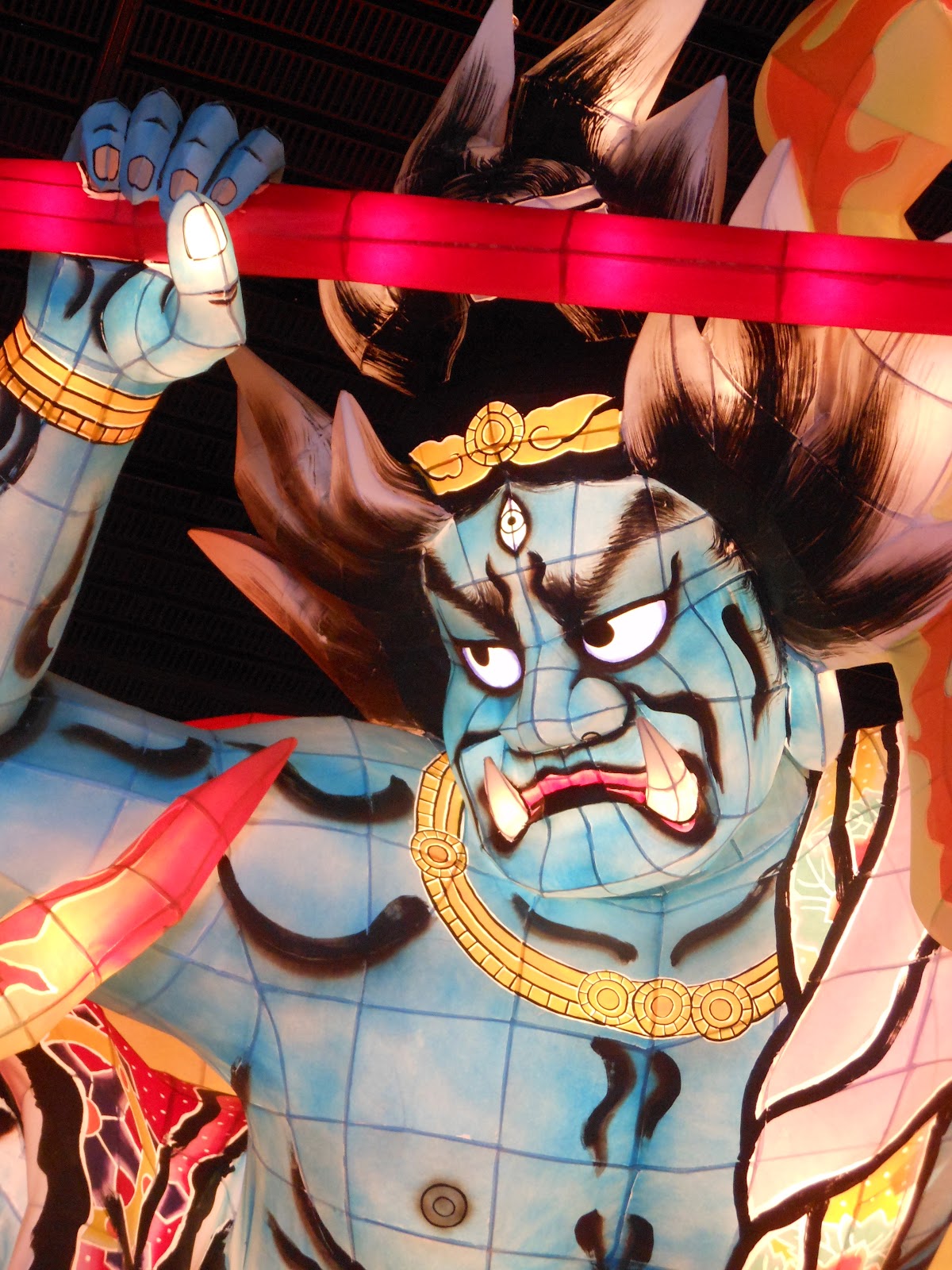
Akita (yes, home of the dog) has a lantern festival each year.   No, it’s not a parade of people carrying fancy lanterns.  It’s a parade of teams of people who alternate holding up a “tree” of 42 paper lanterns each lit by a candle. Topped by the Japanese flag, the tree extends 20-30 feet into the air on a series of bamboo poles.  It sways gently in the wind, sometimes carried but more often balanced on someone’s hand, shoulder, or head.  (You may be able to see this in the picture on the right). 

I got to watch a preview one afternoon at a weekend festival, and then again at night.  The town was celebrating the opening of a new community plaza, formed at the junction of its new Akita Art Museum by Tadao Ando, community center, and shopping building.  There were drummers and dancers, food and music, including a young Japanese woman belting out “Rolling Down the River” in a great American accent.  It was much fun, particularly watching the men balancing their lantern trees on their heads, and hearing the roar of the crowd as the trees swayed precipitously and sometimes fell.

Hirosaki has a lantern festival, too, called the Neputa Festival, but it is a procession of large paper fan-like lanterns, complete with warlike figures on one side and lovely ladies on the other. (I didn’t understand the Japanese explanation.)  From the brochure of the museum I visited, it’s a stately somber parade. 


Aomori’s Nebuta Festival, held at the same time as Hirosaki’s, is fun and grand.  There are dancers in front and drummers and fifers in back of each huge three-dimensional float of paper tigers, dragons, and warriors.  The festival has been around in various forms for decades and now is the largest one in Japan.  The festival is next week, when I’ll be in Sapporo, but I got to see some of the floats under construction, a museum that houses last year’s floats and showed how they were made, and another museum that has some of the older floats.

A hand under construction
See how big the float is!
It was really interesting to see how the floats are made.  Each starts with a drawing of fantastical figures.  There is a basic wooden skeleton, then thin wire that gives dimension to the shapes. Paper is glued on top, and an individual artist paints the figures (apparently the artists compete with each other for best design).  Light bulbs have replaced the candles that were used to illuminate the paper forms.  The entire float sits on a solid wooden frame that also holds a generator to power the bulbs, and this all sits on a couple of tires.  The whole float is pulled – and turned around – by a lot of people. 

The floats are amazing.  There are fierce tigers and dragons and lovely little birds and butterflies.  Most of them are in a traditional warrior style, though I did see a small float of Sponge Bob in this year's array.  It looks like this year’s parade will be like many others – lots of fun, lots of noise and music, and lots of people around this parade of gorgeous lantern-floats.

Thursday, July 19, 2012

16 Months After the Tsunami


I went to three towns along the coast where the tsunami hit last year:  Sendai, Kesennuma, and Kamaishi.  It was important for me to get some sense, in person, of what the area was like and to pay my respects to the strength of the storm and the people who lived through it.  I only saw a little bit, what I could see by foot after getting off the train.  After Sendai, I had to base myself inland, as there was no way to go up the coast by public transportation.  So my impressions are quite incomplete.  To augment it, I strongly recommend you go to YouTube and type in any of the towns’ names and the word “tsunami”.  You will see some very powerful footage.

Sendai.  Like all the towns I visited, Sendai sits up on a hill, descending down to its port.  Aside from the port, Sendai is little changed.  It looks and behaves like any other Japanese city to my innocent eye.  I didn’t figure out how to get down to the port, though I a woman I met who works down there said it’s in pretty bad shape. 


I saw a little bit when I went to Matsushima, the bay north of Sendai that is one of the three most beautiful scenic areas in Japan.  It is indeed lovely, with dozens of tiny rocky outcroppings of islands, all dusted with pine trees on the top.  I came by ferry from a nearby town, Shiogama, which had a pile of debris on the shore still to be carted away and was rebuilding its port.  As I walked along the main street, there were still a few buildings being repaired and one of the bridges to a nearby island had not yet been rebuilt.  But Matsushima is a big tourist area, so repairs were made quickly where the tourists would be.  At least for Sendai and Matsushima, whatever damage that still existed was not where a traveler like me would go.

Kesennuma.  Kesennuma is about 60 miles north of Sendai.  I was several blocks down the hill from the train station before I saw individual empty lots with only a building’s foundation.  Then I noticed that, while there were shops in the first floor of some buildings, they seemed new, spare.  In one there were a group of men and women at tables, making baskets for sale.  As I got closer to the port, I saw more vacant lots, more empty damaged buildings, and then buildings being torn down by giant cranes.  It was interesting to watch:  scaffolding and tarp protected the street sides of the buildings, and behind a crane with Pac-man-like jaws would pull the walls down, pick up pieces, or snap through an I-beam. 


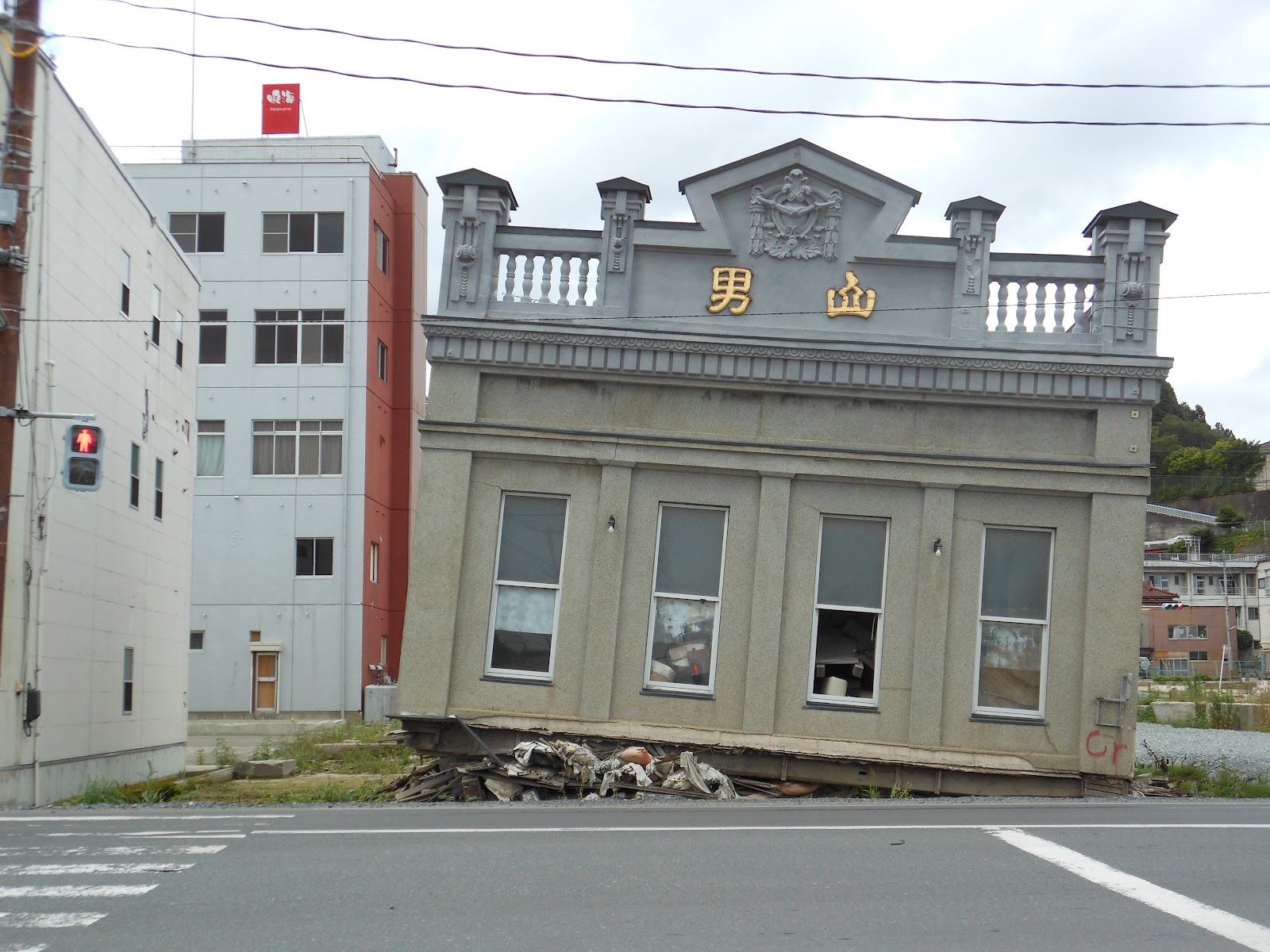
The port and the immediate area around it had been destroyed. There were still some piers angled into the water, and the boats tied up sideways to the quay.  Some buildings remained standing, but they were empty, debris inside, gaping holes in their facades. Pictured here are two that struck me most:  an old copper-clad building in the billboard style I’d seen at an open-air museum, propped up because its first floor had been destroyed by the tsunami wave, and another stone building that had lost its first floor or two entirely and was sitting tilted on the ground.

There was new construction.  There was a new road down to and around the port, a bit higher than the old, so you slid down gravel to the old sidewalk. The only new building I saw down by the port was a three-story parking garage. You could see some temporary housing that looked like container boxes, one housing the police station.  Up the hill, there were some new buildings, or perhaps more accurately newly sided buildings.  In one, I saw men putting in an entire new floor at street level, working around the old woodwork and stairs that led up to the second floor.

I didn’t get a sense of how the townspeople were doing.  They seemed to be going about their business and stores were open.  I saw a number of Japanese walking around, taking pictures as I was.  But generally you heard the noise of the cranes taking down buildings, one by one.

Kamaishi.   A little more than 35 miles further up the coast lies Kamaishi, where I saw much greater devastation than I had seen in Kesennuma.  That may be because the town, which gradually slopes up the hill, lies at the end of a bay with a narrow opening to the sea, which may have added to the tsunami’s force. 

The devastation was extensive, complete, and immeasurable. I'd watched a YouTube video of the tsunami there, even took a picture of what I think was the promontory where it was shot (see right).  Everything was torn up, pushed off its foundation, or gushed through. Even if a building was left standing, its first floor was destroyed, and that meant the supporting pillars might have been weakened and it would have to be taken down.

Vinyl floor of a building
The downtown area and the port were virtually empty, though cars and trucks were traveling through.  The only people walking around besides me were construction workers or engineers.  Amongst the vacant blocks, I saw one or two new buildings and a number standing silently empty, some marked with an X for demolition.  Some structures were being demolished; a concrete foundation was being broken up to be taken away; and in one lot an earth mover was tamping down fresh earth in preparation for laying a new foundation.  In a couple of buildings I saw repairs going on.  But it will take years before there is a downtown again.

The enormity of reconstruction hit me here. There were tons of debris from the tsunami that had to be carted away, and then more debris as the damaged buildings and foundations were cleared.  Much of the town’s infrastructure had to be replaced:  telephone poles and electricity, roads, perhaps the sewer system and gas lines, places for the police, fire, and other government agencies to operate, bus stops and traffic lights.  Meanwhile, the townspeople needed places to live, work, sell their wares, and some reason to feel there was a future worth living.

But renewal had begun.  There was a new main road into town that extended from the railroad station down the hill. The sidewalks looked new or reused. There were new telephone polls and a few old light posts, bent askew. There were new bus stops and even little gardens set into the sidewalks, planted with colorful summer flowers. 
 

In what I thought was a brilliant move, the town had built a three-story box of a building next to the train station.  There, townspeople set up their shops so they could continue their businesses. There were markets, a bookstore, the obligatory omiyage (tourist gift) shop, and upstairs a small Uniglo clothing store.  And there were places where people could gather, sit and talk.  There were three little cafes, all with people in them eating lunch and talking.  There was another gathering place in the middle of the building with long benches, TV screens and a little dais where there could be performances or community meetings.  There was a place upstairs with people to help answer questions related to the tsunami and reconstruction.  For the time being, this was the Kamaishi’s “downtown”.

I don’t think we’ve ever experienced anything as powerful, as vast, quick and destructive as the tsunami was in Japan.  The destruction in Kamaishi seemed so overwhelmingly complete that I am amazed the town could pick itself up at all afterwards.   And yet they and the people in other towns along the coast are doing just that, methodically cleaning up and starting again.   Yes, one could say the Japanese are stoic as they go about the rebuilding, for they have certainly been trained not to bother others or confront.  But I also think their behavior stems from long experience with the natural disasters that occur on this string of volcanic islands sitting on a fault line.   They know such disasters will occur and that you live with them and move on as best as you can. 

Friday, July 13, 2012

Showa Mura and Population Decline


I took a day trip to Showa Mura, nestled in a valley amongst the mountains north of Tokyo, to visit a crafts complex at the suggestion of my weaving friend, Shigeko.  But first, because I didn’t really know where I was going, the bus driver helped by finding the only English-speaking person he knew in the village, began instead at a nonprofit doing community development work here.

The English-speaker, Yoshi Ozaki, is the head of a small nonprofit that was started in 2007 at the village's request.  Showa Mura’s citizens asked a Tokyo-based organization, called NICE, to help them sustain and revitalize this primarily rice-farming community.  The village had declined from a peak of about 5,500 sixty years ago to its present population of just over 1,000, and people were worried the town would die.  NICE sent a small team and now there are six people working in an empty government building that looks somewhat like a school.

Showa Mura ricefileds
I had read an article recently about a young mayor who was working on the same issue of a shrinking population in his town. Yoshi said many villages are facing this challenge, though each one’s situation is somewhat different.  In Showa Mura, demographics and economics were the major reasons for its decline.  Due to the low birth rate, there aren't enough children to replace its aging population.  Many of the children have left because they can't make a living at rice farming.  The government pays rice farmers substantial subsidies, but to the large farmers.  Showa Mura, nestled in a mountain valley, only has small farms. Yoshi said that roughly 70 per cent of the young people said they would prefer to stay if they could make a living here.

To make matters worse, Japan's population -- and hence it's need for rice -- is falling. Showa Mura's citizens believe they will be the last to farm their land and that it will be abandoned after they die.  Many other villages will die, too, and with that, Yoshi thinks, a way of life and value system that is core to Japan.

A Showa Mura community
Yoshi has faced many challenges.   First, while he and his colleagues care deeply for their work and the village, they all came from outside Showa Mura (Yoshi last worked in Tokyo). Even though his board members are all from the village, it has taken time to build trust. The village is comprised of ten different communities, each with the same issue but each with different needs.  And there are no easy solutions. At least Yoshi and his staff can build upon Showa Mura’s traditional spirit of community cooperation and caring for each other.  Still, the work is difficult, solutions murky, and progress slow.

As Yoshi and I talked, I remembered an exhibit I had seen of work by Japanese potters in the 1920's and '30's. They were trying to find an alternative to modernizing Japan by Westernization, and looked Eastward for a new way that was more closely aligned with Japan's traditional values.  I've seen that same conflict between east and west in other areas:  as obi weavers, calligraphers and other artisans modify what they make for a more "modern" market, and even in the sharp contrasts that run through Tokyo.  Japan has managed to live in the middle between old and new, East and West for 150 years and keep its values of deep respect for all living things and caring for each other.  It will be interesting to see how Japan grapples with this new challenge of a declining population.