Wednesday, November 14, 2012

Two Quick Trips – and Christmas!

So what do you do after you’ve been moving from one city to another every couple of days for 2½ weeks?  Do it some more!  I spent a few days in Taipei and a couple of days in Yokohama before settling in Kyoto for a couple of months.  On the way, I discovered Christmas in Japan. 

Chiwen (Owl-mouth) gargoyle, Confucius Temple
I joined my New York friend, Joyce, In Taipei for a few days before she went on to Kaohsiung to give a lecture.  I found the city to be a study in contrasts.  It is a modern, developed country – think of all the labels saying “made in Taiwan” – but is also something of a backwater, somewhat ignored and forgotten.  Joyce said the Chinese have systematically had Taiwan “de-listed” from various global indices, so there’s little readily available information on a number of topics. 

Taiwan is predominantly Chinese, with brightly colored and elaborately decorated temples.  But it is also Taiwanese, an island of an independent people with their own style of Chinese food.  Because it was under Japanese control for fifty years until 1945, there is some Japanese influence.  But it is distinctly not Japanese in its behavior, which is louder and more aggressive.  In Taipei, people don't stand patiently in line; rather they push and elbow you away.   

Taiwan National Concert Hall
Chiang Kai Shek Memorial Museum
I remember Taiwan as being the place where Chiang Kai Shek went after the Communists took control of China.  That is true, but what I didn’t realize is that the Taiwanese consider him to have been a dictator and were quite happy when he died.  Still, there is a grand, weighty, almost reverential museum in his honor, with the equally substantial National Theatre and Concert Hall on either side.  It was interesting to note the people who visited Chiang:  there were photographs of him shaking hands with Nixon, Johnson, and Reagan, along with the presidents of Nicaragua and other smaller countries, but none from Europe that I recall.

Taipei 101 (Google photo)
Like every city, Taipei is a mix of old and new buildings.  It has Taipei 101, the tallest tower in the world until Burj Khalifa opened in Dubai in 2010.  The bamboo-shaped tower is surrounded by new skyscrapers filled with offices, shops, restaurants and apartments.  Elsewhere, there are lovely little areas of galleries, shops and restaurants in well-kept low buildings.  I also saw more run-down areas, where concrete buildings looked unkempt, seemingly uninhabited, and ready to fall down. I was told that the buildings are left to decay, and when they collapse developers move in to redo the area. 

Taipei has a modern and efficient subway system that whisks its 3 million people around.  It is like the newest Tokyo lines:  sparkling stations, Plexiglas walls to prevent you from falling onto the tracks, and quiet, smoothly running trains.  And it’s cheap:  a ride costs about 70 cents, which you can’t beat.  For more local travel, there are motor scooters, seemingly one for every citizen.  The scooters move up to the front at traffic lights, and then buzz off ahead of the cars when the light changes.  They look and sound like low-flying bees.

Yokohama also has its new area, this one near the port, with its Landmark Tower, not nearly as tall as Taipei 101, apartment and office buildings, shops and restaurants.  I was there because of Yokohama Quilt Week, an exhibit held in the Pacifico Exhibition Hall down by Yokohama’s waterfront.  I’m a quilter, so of course I would go, just as I had gone to see the lovely Quilt Nihon show in Tokyo in the spring.


Quilt Detail
6-inch miniature quilt
The exhibition was similar to the larger American quilt shows, with traditional and contemporary art quilts, theme-based exhibits, and lots of vendors.  In size, it was about a third that of Houston’s International Quilt Festival.  Patchwork quilting is an American traditional craft form, and the Japanese have adopted it, using the same patterns, though often piecing and quilting entirely by hand.  The quilts varied in quality, with the prize-winning quilts being quite good and other “volunteer quilts” as they were called, being less so.  They also ranged in size from three gigantic ones that hung like banners from the ceiling to those that were 6” square.  The show featured exhibits by an Italian artist, Marian Fruehauf, that was quite interesting, and also the stunning Studio Art Quilt Association’s (SAQA) trunk show of 44 miniature quilts (Google “SAQA trunk show” or go to http://www.SAQA.com).

My Japanese friend, Shigeko, came to visit the quilt show with me and then we went back to her home in Kamakura.  There we went to her husband’s Polaris gallery, a small space surrounded by trees up the hill from their house.  Polaris had a felted art installation by Hinako SATOH.  Like other works at Polaris, it was an installation that was both inside and outside the glass gallery, incorporating the nature outside. Satoh-san, her husband, and some friends were there, so we celebrated with a sushi dinner in the gathering room upstairs.
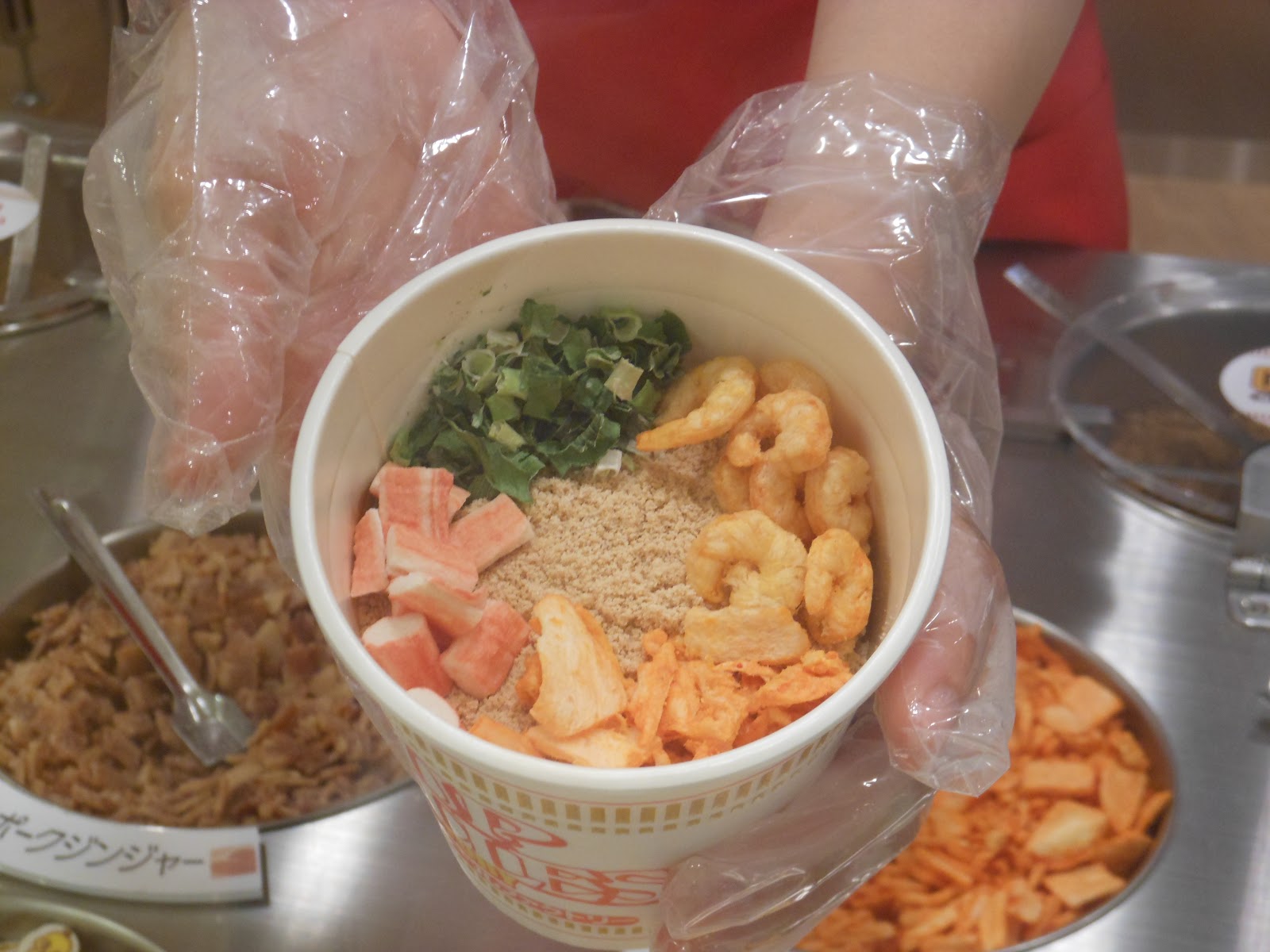

Yokohama presented its own fun food experience at Cupnoodle Museum, which celebrates the work of Momofuku ANDO, the creator of ramen noodles in a cup, those ubiquitous Styrofoam cups of dried squiggly noodle meals where you add hot water, wait a few minutes, and eat.  I learned how Ando invented ramen to provide an inexpensive, easy meal for the working class, then marketed and expanded it worldwide, including creating ramen used in space travel.  Along with others, I got to make my own ramen, selecting my desired ingredients as the assembly line added noodles to the cup, sealed, wrapped, and delivered it with a smile.

As I headed back to the subway through the shopping complex near Landmark Tower, the lights suddenly went dark.  Power outage?  No.  Soon I heard music, and not just any music, Christmas music.  Next the large, artificial Christmas tree in front of me lit up, first with little red and yellow lights, then with a swirly flower, strings of lights, and finally the whole tree, to a tinkly rendition of the “Hallelujah Chorus”. When I asked Shigeko about this holiday in a Buddhist and Shinto culture, she said the Japanese love festivals and have adopted Christmas as another one to celebrate.  It’s also a time for giving presents, she said for children, though I suspect everyone participates.  So the season has begun in earnest, even here.

Saturday, November 3, 2012

Bamboo, Buildings and More – A Fantastic Tour of Japan

 
I am not a tour person, preferring instead to travel with a friend(s) or by myself rather than having a guide lead me by the nose.  But the Tai Gallery in Santa Fe (www.taigallery.com) offered an irresistible opportunity to meet with contemporary Japanese bamboo artists, meet new people, and see Japan through others’ eyes. 

Tour Leader Andy Bender
In mid-October, I joined nine other Americans for two weeks of bamboo, architecture, food, and sights across Japan.  It was a fabulous trip – we were a diverse, interesting, and congenial bunch who made it a point to never be late and to try anything.  Our tour leader, Andy Bender, was fantastic.  He had spent years in Japan; explained much about the country’s history, culture and values; and showed us all sorts of interesting things.  He’s also a journalist who, in addition to his own blog (www.wheres-andy-now.com) frequently writes for Forbes.  The places we saw, the hotels and ryokans where we stayed, and the food we ate were all terrific.  I couldn’t possibly describe everything, but here is a taste of the range of what we saw.

Fujitsuka Shosei, bamboo artist
 BambooWhat amazes me about Japanese craft art is the artists’ ability to combine incredible technique with energy and innovation. To me it is what makes Japanese art distinctive, whether ceramics, lacquer ware, wood, or bamboo.  On the tour, it was such a thrill to meet several of Japan’s finest bamboo artists, look at their work up close, talk with them about what inspired them and how a piece is made, and then to watch them at work.


Shono Tokuzo
Basket by Shono Toku
 The people we met were generally in their fifties or sixties, lively, humorous, interesting men who lit up when they talked about their art.  One spoke of being inspired to use the shape of a Jomon pot, the earliest Japanese pottery made between 10,000 and 300 BC.  Another focused on structure, building off a hexagonal base.  A third liked to create unusual bamboo forms, sometimes starting with bulbous piece he had found in the woods, another time leaving a bit of bamboo in its round form as a “face”, then splitting the rest into fine strips and plaiting them to create the shape of a tall, sensuous woman.

Nagakura Kenichi basket
Beppu Occupatinal School Student
Becoming a skilled bamboo artist takes decades.  All the artists we talked to spoke of learning to split bamboo over a period of 3-5 years; they didn’t make their first simple basket until late in their first decade of apprenticeship.  The difference was stark when we watched young students in a yearlong program at the Beppu Occupational School, laboriously splitting and trimming bamboo, often with carefully taped fingers.  In contrast, Shouchiku Tanabe, the fourth generation in his family of bamboo artists (known as the Chikuunsai), chatted with us as he sat cross-legged, splitting bamboo into increasingly narrow strips without looking.  While the Beppu students used calipers and miters to carefully measure and trim their strips, Tanabe casually tapped two metal triangles into his sawed-off log table, then quickly pulled the bamboo through to trim it off, knowing by eye it was the correct width.

Kawano Shoku basket
Basket by Yuju Shohaku
Tanabe demonstrated the impact of being the latest of several generations of bamboo artists, something I’d also seen with ceramicists.  He used tools his great-grandfather had made, simple and effective.  (Another artist modified his father’s studio to prevent getting a bad back.)  More important, Tanabe started playing with bamboo, even splitting it, when he was three or four and watching his father and grandfather at work.  The young Beppu students do not have that advantage.  The Chikuunsai family is the only one of the leading bamboo families in his area where there is someone to succeed the current artist:  Tanabe has two daughters and a newborn son, and at least one will undoubtedly go into the business.

Mr. Mori
Indigo dye vats
Indigo.  I keep being reminded that in Japan, traditionally one’s occupation passed from father to son for generations.  For example, for the past 140 years the Mori family has dyed silk and cotton yarns as well as paper using natural indigo. In fact, the Moris made the paper blue and white screen Betsy and I saw at Katsura Imperial Villa.  Mr. Mori, a lively, active man in his early 60’s, showed us the process with the aid of his son, who will eventually succeed him.

The Moris showed us the indigo plants, whose leaves are the basis for the dye and flowers form the seeds for next year’s crop.  The leaves are dyed, piled high, and then fermented to turn into dark clumps of dye that will keep for years.   Dissolved in water in deep pottery vats, the dye is ready for yarn to be dyed.  A light blue will be dyed three times to set the color, while the traditional dark blue will be dyed as many as twelve times.  It was fascinating.


I also continue to be amazed by Japan’s contemporary design.  We visited Nuno Textile Studio, a company based in Tokyo headed by Sudo Reiko, a delightful, creative fabric designer.  She wants to provide beauty for all, using today’s industrial manufacturing techniques to produce fabric in quantity.  Her fabric is used in curtains, upholstery, and in scarves and other clothing that you can find at MOMA, among others.  She focuses on design, and then works with the technical people to get it mass-produced.  For example, she has sandwiched thin strands of paper between two gauzy pieces of fabric (the bottom piece in the picture) and made fabric using plastic-coated copper telephone wire (the top two samples). 

Omotesando Buildings
Architecture is another place where you see both the traditional and the modern. Our tour guide Andy loves architecture (so do I), and he pointed out a number of interesting buildings as we traveled.  We saw the shopping/hotel/office complexes of Tokyo Midtown and Roppongi Hills, both of which transformed a rather grungy area of Tokyo, and Omotesando, a high-end shopping avenue with little side streets catering to the younger, hip Japanese.  We ate lunch in Omotesando Hills, a Tadao Ando building with a series of ramps leading to various shops and restaurants. 


Later in the tour he walked us through the Ando museums at Naoshima, which look to me like an art installation, where building and art come together.  We also went to the Miho Museum outside of Kyoto, where IM Pei designed a stunning stone and glass museum set into a mountain, with its roof resembling a traditional Japanese farmhouse.

Fujiya Hotel
Shrine in Hakone
We also saw traditional architecture.  We saw the first western-style hotel in Japan, the Fujiya Hotel in Miyanoshita, Hakone.  Later that same day we visited a small shrine in the misty rain, surrounded by tall cedars.  There is nothing more lovely.

Food.  To say we ate well would be an understatement.  At a formal dinner at a traditional Japanese ryokan, the only sounds you could hear were the amazed “ooohs” and savoring “mmmms” as we ate.  We had a number of delicious meals of little dishes, the food always fresh, natural, and beautifully prepared.  Andy would explain what we were eating and how to do it, making even the wary willing to try.  He also pointed out foods as we wandered in Tokyo’s Tsukiji market and Kyoto’s Nishiji Food Market.  He made us all converts, to the point that on our last day, we asked him to have our bus stop so we could have some black sesame ice cream.  Ah, the foods I will miss when I get back home!

Sunday, October 21, 2012

Japan through A Good Friend’s Eyes


Heian Shrine
Betsy and me at Karuizawa
For the last three weeks my good friend Betsy came to visit.  It was such a treat having her here and discovering Japan from someone else’s perspective.  It’s fun to see the different ways people are drawn to this country.  We spent most of our time in Kyoto, where Betsy was fascinated by old Kyoto – the machiya (old wooden buildings), tea ceremony, ceramics, etc.  We relied heavily on Old Kyoto and Exploring Kyoto, which focused on the old shops still doing business and the side streets that reveal what the city was like during the Edo period.

Betsy at a tea ceremony
On our first day, we happened upon the Sen-oku Hakukokan, a museum housing the Sumitomo family’s art collection.  There we saw a wonderful display of tea ceremony utensils:  beautiful macha bowls for the powdered green tea, gorgeous ceramic tea caddies with ivory lids and silk tea cases, pottery water containers and iron braziers and pots to heat the water.  Betsy was hooked:  we went to not one but two tea ceremonies, learning about and appreciating the ritual, the symbolism, the respect for each other and the ceremony vessels, and of course the macha itself.  Later, at the monthly antiques market at Toji Temple, she found a beautiful old macha bowl to take home.  As we wandered the pottery shops, we spent a lot of time looking at other bowls and tea caddies, but nothing seemed quite right.  Finally at Ippodo, an old and excellent tea shop, she found what she wanted: a macha set complete with whisk, spoon, little tea caddy and macha.  We also learned that loose tea should be drunk within two weeks of opening the packet, so Betsy will be having lovely tea ceremonies daily after she returns to Denver.

We explored other aspects of old Kyoto as well.  We went to Gion to see a maiko performance, Edo-period dance and music performed by maiko, i.e., geishas in training to acquire the skills needed to entertain gentleman:  playing the shamisen, dancing and carrying on a lively conversation (they read the newspapers to keep up to date on current events).   We watched the maiko dance slowly, often using fans, while others played or sang the somewhat atonal music.   Another day we went to Shimabara, Japan’s first licensed “pleasure quarter”, on Kyoto’s west side. The prostitutes, who were slaves, were kept in this walled part of town so they could not escape, which proved to be a disaster when they perished a fire in the mid 1800’s.  There we visited the Sumiya, a big hall where men were entertained with song and dance, with smaller rooms on the upper floor for sexual pleasure.   Still another day we went to an old machiya that had formerly sold kimonos and now catered to tourists, offering them the chance to try one on and attend a tea ceremony (we only did the latter).
 
Moss at Saihoji
Of course we went to see some of Kyoto’s temples and gardens.  Friends had recommended we go see Saihoji, known as the Moss Temple because of its lovely garden covered with many varieties of moss.  The walled garden looked like a miniature of a much larger one, with young saplings rising from small undulating hills covered in moss.  

Katsura Imperial Villa
The Moss Temple was quite a contrast to Katsura Imperial Villa, a beautiful, expansive garden about half an hour outside of Kyoto. There, on an hour-long tour in Japanese, we struggled to take it all in:  the lake with a narrow peninsula built to look like the Amanohashidate Sand Bar I’d seen in the summer, maples just starting to turn, serene tea houses with stunning views framed in their windows, and many lanterns and walks, each unique.  Everywhere we turned, we saw a different view.   

Part of Ryoanji's famous rock garden
Ryoanji Temple offered another contrast with its moving and serene rock garden.  There, after some searching, we found the temple’s restaurant and had a wonderful yodofu (boiled tofu) lunch overlooking another garden, a lovely pond with water lilies bordered with pines.

Sightseeing wasn’t just temples and gardens, however. Betsy was fascinated with the many charms dangling from people’s cell phones.  “How are they attached?” she kept asking as she peered around, trying not to look too obvious (Japanese phones have little eyelets built into the case specifically for them).  “What are they for?” she would ask, and learned that in this Buddhist/Shinto society, people want charms to ward off evil, attract good health, etc.  Later she would buy charms at temple tourist booths, intrigued by the different purposes (for business luck, to be a good student, etc.).  She was amazed that men, too, had charms, sometimes stuffed kittens 3-4” tall or one with a stuffed red bow with white polka dots.   Wisely but with a tinge of regret, she decided against getting any for her husband, son or son-in-law.

We also had much fun watching children, who danced and laughed and “were boys” just like children everywhere.  We took a day trip to Osaka to see the Outdoor Village of Old Farmhouses, and saw many classes of children going through the train station, each group identified by a different cap, all walking in line, two by two.  We watched them divide into groups of 5-6, each with assignments, then run around to collect pine cones or other plants, visit the houses to find answers to the questions, etc.  Later, as we headed home, we saw the school children sitting on the platform in neat lines, waiting for the train.

After savoring old Kyoto, we went to Naoshima, the island in the Inland Sea that I love for its amazing integration of sea, land, light and contemporary art and architecture.  We savored the art on the walls and sculptures on the grounds, and enjoyed exploring the new museum of the Korean artist, Lee Ufan, with his serene, engaging, minimalist installations.  We drank in the sunsets, relished the delicious food, let the cool air into our hotel room overnight, and gazed out at the sea. 

Pedestrian crossing sign
On Monday, when most of the museums were closed, we went to Honmura, the small fishing village that was dying and is now lively with new cafes and art house projects.  We walked past the older buildings, sided with wood charred to keep out bugs and bad weather, some with hand-designed noren (banners) over their doors.  Betsy loved the sign with two elderly Japanese, warning people to let pedestrians have the right of way.  But our favorite, as for everyone, was Yayoi Kusama’s iconic Pumpkin, especially when it glistened in the sunset.

Karuizawa waterfall
Mima with Sadie, Betsy, and Kim
Last, we went up into the mountains for a couple of days, to Karuizawa about an hour’s shinkansen ride northwest of Tokyo.  Karuizawa is an unpretentious summer resort town for the wealthy, with large, western style houses just visible amongst the trees.  It’s also the place where Japan’s current emperor met and fell in love with his future wife.  We stayed with two of Betsy’s friends, Kim and Mima, in their lovely home with large windows looking out onto trees and moss.  It was distinctly cooler there than in Kyoto or Naoshima, so we were glad to bundle up in the down jackets Kim and Mima lent us and enjoy the wood fire as we sat and talked.  We went to an onsen the first night and the next day went to see some beautiful waterfalls nearby, one of which reminded me of a small Niagara Falls.  That afternoon turned rainy as the tail of a typhoon passed through.  So we settled down inside, first with naps and later with sushi in huge round bento boxes, delivered to our door by a man in white garb and a chef’s hat. What a wonderful time we had!

So that was my time with Betsy:  much fun, sharing what I loved, discovering new things through her eyes, savoring Japan’s serene beauty and rich history, and making new friends.  What more could one ask for?!