Shikoku’s 88 Temple Walk was an amazing experience, part
spiritual retreat, part nature hike, and part adventure. We climbed long steep forested paths to
suddenly find a serene temple, other pilgrims resting or praying, and a glorious
view of the area beneath our feet.
We experienced great kindness, ate terrific food, and had marvelous
adventures.

 The 88 Temple Walk, or “Hachijuhakkasho” as it’s said in
Japanese, is a tour of the Buddhist temples that are associated with
Kobodaishi, the founder of the Shingon sect of Buddhism. Kobodaishi, who lived from 774-835, was
a Japanese Buddhist monk, scholar, civil servant, and poet. He is said to have visited or
established each of the temples on the pilgrimage, which he supposedly walked
himself. Most pilgrims (henro) today do not walk the route, nor do they do it
in one trip: it is long (1200 km or about 550 miles), arduous, mostly on paved
road, with long distances between some temples. Instead they bike, drive, and/or take the train. We, too,
took advantage of buses and trains.
Regardless of how a person does the trip, or whether alone, with family,
or on a tour, making the pilgrimage is respected and valued.
The 88 Temple Walk, or “Hachijuhakkasho” as it’s said in
Japanese, is a tour of the Buddhist temples that are associated with
Kobodaishi, the founder of the Shingon sect of Buddhism. Kobodaishi, who lived from 774-835, was
a Japanese Buddhist monk, scholar, civil servant, and poet. He is said to have visited or
established each of the temples on the pilgrimage, which he supposedly walked
himself. Most pilgrims (henro) today do not walk the route, nor do they do it
in one trip: it is long (1200 km or about 550 miles), arduous, mostly on paved
road, with long distances between some temples. Instead they bike, drive, and/or take the train. We, too,
took advantage of buses and trains.
Regardless of how a person does the trip, or whether alone, with family,
or on a tour, making the pilgrimage is respected and valued.
The Henro Garb. My
friend Gabriella and I were a bit dubious when we first donned our henro garb
at Temple #1 in Tokushima: a white
cotton jacket, a conical sedge hat, and a walking stick. We felt this all a bit silly, but as I
put on the white jacket, I felt a calmness settle upon me. The stick became a valuable walking aid
and the jacket was good sun protection.
The hat was a mixed blessing – a great rain hat or sunshield, but
useless in wind and bulky to carry.
 Our henro attire was a signal to others – people knew us as
pilgrims on sight. We could easily
strike up a conversation with fellow henro, ask where they were coming from
and going to, or seek advice on the best route to follow. People we met on the roads were
invariably kind, helpful, and often impressed with our walking effort as well
as our Japanese. We were
delighted, especially Gabriella who loves and is fed by being able to connect
with people of different cultures.
Our henro attire was a signal to others – people knew us as
pilgrims on sight. We could easily
strike up a conversation with fellow henro, ask where they were coming from
and going to, or seek advice on the best route to follow. People we met on the roads were
invariably kind, helpful, and often impressed with our walking effort as well
as our Japanese. We were
delighted, especially Gabriella who loves and is fed by being able to connect
with people of different cultures.
 Temples and Nature. Gabriella
and I chose to focus on the temples in the more rural areas of Shikoku,
particularly the southern half of the island. We settled into a routine: up for a full breakfast at 6:30, then on our way: often on roads through small villages
and farmers’ rice fields, always with the mountains in sight. In Shikoku's southern curve, we would walk
near the vast Pacific, watching its changing color, the fishing boats, gazing
outward to our left and up to the mountains on our right. Frequently a temple was up in the
hills, so we climbed through forests of “Yamamatsu” (mountain pine), tall stately
old pines, deciduous trees, and sometimes bamboo. We would hear the birds, sometimes a brook, always the
thump, thump, thump of our walking sticks. A hill temple was built so that you didn’t see it until you
climbed the last steps. Then
suddenly it appeared on a flat clearing, several buildings, sometimes a lovely
garden, and often a stunning view across the hills and to the sea. Shikoku's mountains, sea, trees, temples, and spirit became one.
Temples and Nature. Gabriella
and I chose to focus on the temples in the more rural areas of Shikoku,
particularly the southern half of the island. We settled into a routine: up for a full breakfast at 6:30, then on our way: often on roads through small villages
and farmers’ rice fields, always with the mountains in sight. In Shikoku's southern curve, we would walk
near the vast Pacific, watching its changing color, the fishing boats, gazing
outward to our left and up to the mountains on our right. Frequently a temple was up in the
hills, so we climbed through forests of “Yamamatsu” (mountain pine), tall stately
old pines, deciduous trees, and sometimes bamboo. We would hear the birds, sometimes a brook, always the
thump, thump, thump of our walking sticks. A hill temple was built so that you didn’t see it until you
climbed the last steps. Then
suddenly it appeared on a flat clearing, several buildings, sometimes a lovely
garden, and often a stunning view across the hills and to the sea. Shikoku's mountains, sea, trees, temples, and spirit became one.

As we entered the temple grounds, we paused, then washed our hands using
ladles at a stone basin filled with water. We wandered the grounds and stopped at each temple to give thanks and
contemplate a bit.
Sometimes we lit a candle or incense, sometimes listened to the chanting
of other pilgrims. Finally, we
went to the “nokyo-cho”, the place where a Buddhist monk or hired person would stamp the temple seals and sign our temple book in flowing calligraphy.

 We discovered that each temple had its own personality. Those in the mountains were often the
most serene, while those in the towns tended to be a bit more anonymous and
matter of fact. Some were lovingly
cared for: we arrived at one
temple after a particularly arduous climb to find pilgrims relaxing under an
arbor, a beautiful vase of flowers set in a niche in the temple wall, and a
gardener shaking the last of the magnolia blossoms off a tree. It was magical.
We discovered that each temple had its own personality. Those in the mountains were often the
most serene, while those in the towns tended to be a bit more anonymous and
matter of fact. Some were lovingly
cared for: we arrived at one
temple after a particularly arduous climb to find pilgrims relaxing under an
arbor, a beautiful vase of flowers set in a niche in the temple wall, and a
gardener shaking the last of the magnolia blossoms off a tree. It was magical.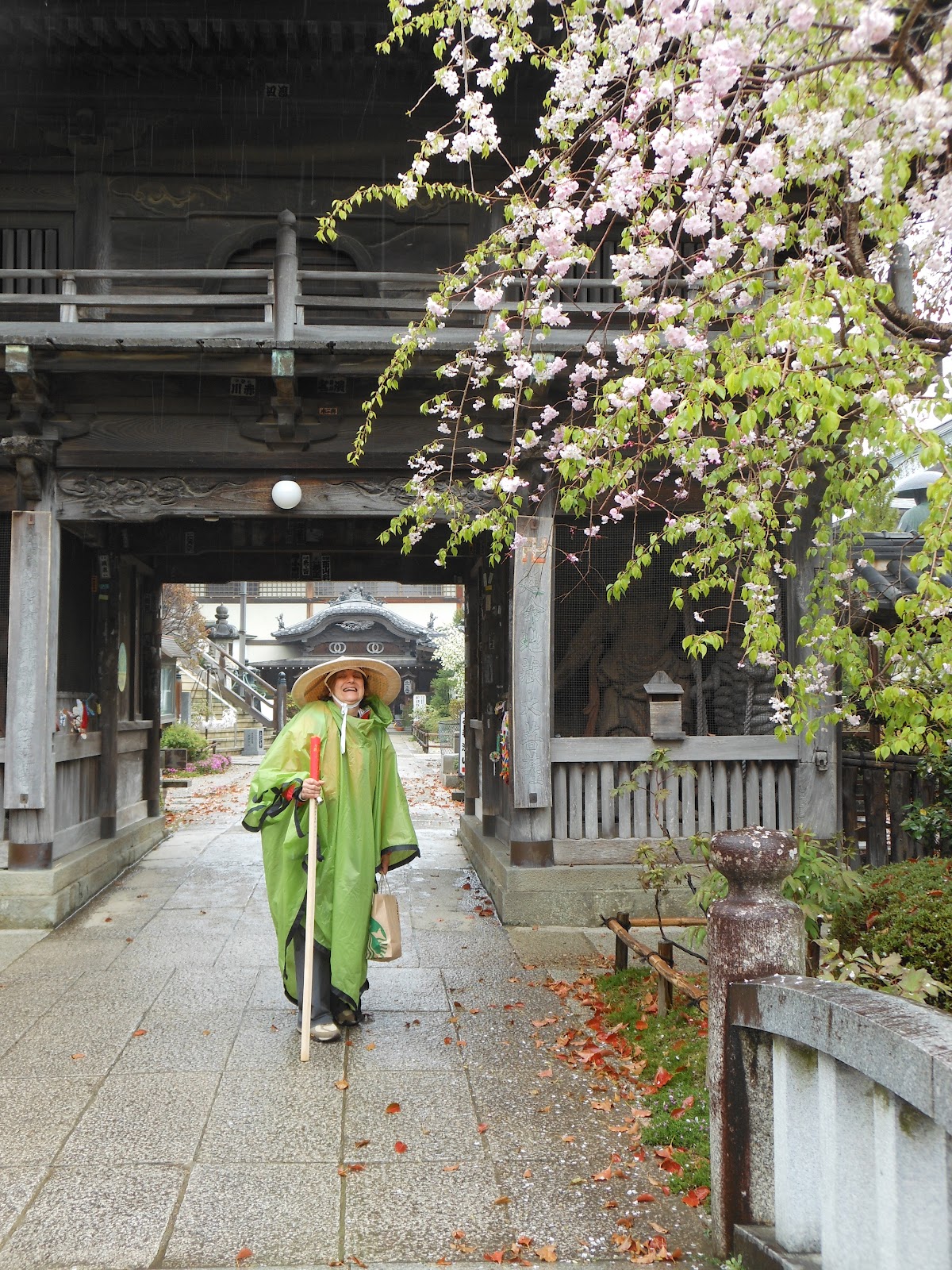
 Nature being what it is, we also walked through mist and
rain, Gabriella in a huge flowing Kermit-the-frog green poncho, and I in my
subdued “ready-for-the-city” mud brown Muji slicker. The worst day was a hard, all-day rain when we traveled east
to west past Kochi. It was raining
so hard that the innkeeper arranged for a couple to drive us down to the train
to and beyond Kochi. To get to our
hotel, we had to walk along the shore, the sea an angry grey with waves
pounding, then across a bridge to the Yokonami Peninsula in
driving rain. I, who had stopped
in Kochi, clutched rolls of hand-made paper I had bought, carefully wrapped in
clear plastic, held my rain hood close, and bent my body into the wind.
Gabriella and I each arrived looking like drowned rats, our feet and pants
soaked.
Nature being what it is, we also walked through mist and
rain, Gabriella in a huge flowing Kermit-the-frog green poncho, and I in my
subdued “ready-for-the-city” mud brown Muji slicker. The worst day was a hard, all-day rain when we traveled east
to west past Kochi. It was raining
so hard that the innkeeper arranged for a couple to drive us down to the train
to and beyond Kochi. To get to our
hotel, we had to walk along the shore, the sea an angry grey with waves
pounding, then across a bridge to the Yokonami Peninsula in
driving rain. I, who had stopped
in Kochi, clutched rolls of hand-made paper I had bought, carefully wrapped in
clear plastic, held my rain hood close, and bent my body into the wind.
Gabriella and I each arrived looking like drowned rats, our feet and pants
soaked.
Lodging. Where did
we stay? If we could, we stayed in
“shukubo”, or temple lodging. We had a lovely, spacious tatami-mat
room and fabulous, large, tasty dinner and breakfast with the other pilgrims
who were staying. Sometimes we
stayed in “minshuku”, Japanese guesthouses, varying from lovely to a bit tired
and worn, but friendly and with good food. A couple of times we stayed in traditional Japanese ryokans,
one a 120-year-old house that had been in the family for three generations and
was run by an elderly couple. In
Uwajima and Matsuyama, towns in northwest Shikoku, we stayed in youth hostels,
friendly places with a mix of guests:
young, old, and some families.
Other than the hostels, which were full during Golden Week, we ranged
from being the only guests to one of several. That gave us, particularly Gabriella, the opportunity for
many good, one-on-one conversations with our innkeeper and fellow guests.

 The O-settai Tradition.
“Never refuse an act of kindness” is a henro precept; it is
inconsiderate and a rejection of the giver. O-settai is a gift given to pilgrims, sometimes by other
henro, often by people you meet on the road. We were grateful beneficiaries.
The O-settai Tradition.
“Never refuse an act of kindness” is a henro precept; it is
inconsiderate and a rejection of the giver. O-settai is a gift given to pilgrims, sometimes by other
henro, often by people you meet on the road. We were grateful beneficiaries.
We often received food as o-settai: one man came out from his truck to greet
us with hard boiled eggs, while another gave us a bento lunch. Many gave us mikan, a tart and juicy
orange/lemon citrus fruit that grew all over southern Shikoku. One time when we were lost in a citrus
grove, the man who helped us gave us each three mikan, luscious but heavy for
us back-packers. We returned the
favor by giving some to others we met.

Sometimes we received services: on that rainy day up in the mountains, the couple who drove
us to the train station did it as an o-settai. The man from the citrus grove drove us in his truck down the
valley to the road we were looking for.
Later that same day, a man and his 9-year-old daughter saw us seated on
a bench near the road, hot and tired.
They walked over and we began a conversation, learning that his daughter
was the piano student we had heard earlier. He invited us to his house nearby, where his wife served us
iced tea on the veranda and he filled a tub with cold water to soak our
feet. Their house was beautiful
and lovingly done: in a western style, it was designed and built by a westerner
who was there on home stay while his wife taught English in the village school. Inside was a hand-made wooden dining
table, a tatami family room, and lovely wood cuts from the region. We were so thankful, not just for the
tea and footbath, but for the opportunity to talk and see their home.
Ofuro, the Japanese Bath.
There is nothing in the West that is quite like a Japanese bath: it is fun, cleansing, relaxing and
luscious. We looked forward to it at the end of each day.

In a Japanese bath, you first sit on a stool and
clean yourself thoroughly, using a hand shower or a bowl to pour
water over you. You wash your
hair, your body, taking as much time as you want to make sure every pore is
clean and fresh. Then, after
rinsing yourself completely, you step into a hot water bath. Ideally the water is 43ºC (about 100ºF)
and sometimes the water is from a hot springs. You can sit in the water as long as you wish, sitting on a
small step, going neck deep, or if the bath is large enough, walking around. If you’re Gabriella, you also swim,
grinning from ear to ear.
The smallest baths we had were in tubs just big enough for
the two of us to fit, face to face, legs bent up to our chest. Many were a shallow pool big enough for
several women to lie comfortably facing each other. At the hotel we stayed at after that horribly rainy day, the
bath was half indoors and half outdoors.
We went outside under a covered area and watched the raindrops splashing
into the pool beyond.

The biggest and most fun bath we visited was the Dogo Onsen,
a famous old bath in Matsuyama, near the youth hostel where we stayed. It’s a huge wooden facility with a
receiving hall and separate changing room, shower, and bath for each gender (as was
true everywhere). We were there
during Golden Week, a major Japanese holiday, so the onsen was crowded. There were lines of people waiting to
buy tickets, often dressed in their hotel’s yukata (robe), happi (warm
jacket), and slippers, carrying a little basket with their towel. In the bath there were women of every
age, size and shape, all comfortable in their nudity. I watched a young girl standing, waiting to step in next to
more matronly types. I saw a woman almost doubled over with osteoporosis,
spine jutting out, walking on sticks of legs with equally thin arms,
with a kind face and curiosity and delight in her eyes. Despite the crowds, everyone was having
a good time. The women were
laughing, chatting, walking in the pool, making room for others. In fact, the only uncomfortable person
I saw was a young, heavy American woman, who looked like she wasn’t quite
prepared for this scene from an Impressionist painting.
Regardless of its size, sitting in the bath is a time to
rest, relax, and chat. When you
feel sufficiently rejuvenated or too hot, you get out, towel off, and
dress. Every muscle in your body
is relaxed and your skin feels like it’s been kissed.
Next blog: Shikoku adventures and food!